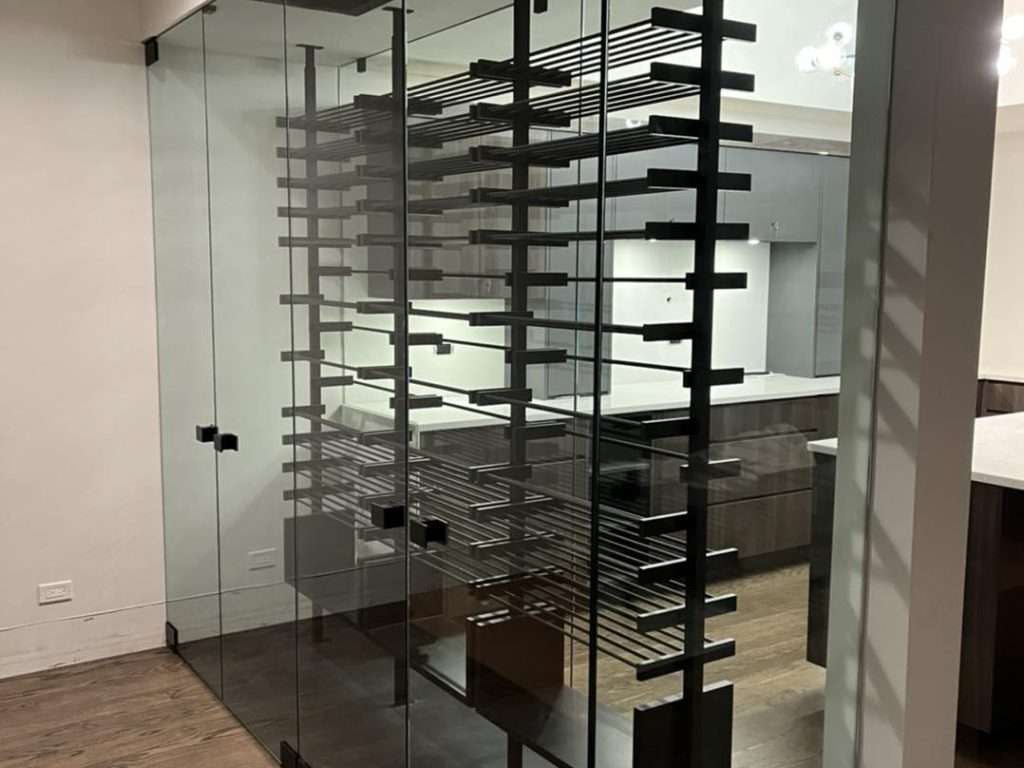
Key Takeaways:
A glass wine cellar door is a framed or frameless door, glazed in single-pane or insulated glass, that keeps a collection visible as the room behind it holds its storage conditions. In an actively cooled cellar, those conditions are roughly 55°F and about 60% relative humidity, which is the range that lets wine age slowly and keeps corks intact. The door's job is to hold that environment steady while hiding as little of the room as possible. Those two goals pull against each other, and that tension is what makes the door the most consequential piece of the build.
This guide from Tim's Glass & Mirror walks through the design options worth understanding before you order, the insulated-glass question that almost nobody answers straight, why the seals and hardware carry more of the load than buyers expect, what tends to go wrong in glass wine rooms, and how to write a specification that holds up.
Most glass cellar doors fall into one of a few families, and the choice sets both the look and the thermal performance. The distinctions worth knowing before you talk to a fabricator are these:
Glass choice runs alongside the frame decision. Standard clear glass carries a faint green cast that shows on thick panels, so low-iron glass is the usual upgrade where a collection is being lit and photographed. Frosted, reeded, and decorative treatments are available on any of these, though every treatment trades a little visibility for a little privacy.
This is where published advice splits, and the disagreement is real. Some glass shops will tell you a refrigerated wine enclosure does not need insulated glass. Cellar-door manufacturers and cooling-system makers say double or triple-pane insulated glazing is the floor. Both camps are describing something true, and the thing that separates them is a number nobody states out loud: the temperature difference across the glass.
A display wall that sits at room temperature has almost no differential across it. Single-pane tempered glass is perfectly defensible there, because there is no meaningful heat to move and no surface cold enough to condense on.
A cellar held at 55°F inside a house kept at 70°F is a different building entirely. That is a fifteen-degree differential across a material that conducts heat readily, and single glazing on that differential will run cold enough on the room side to sit below the dew point and sweat. For an actively cooled room, double-pane insulated glass at roughly R-2.5 to R-3.0 is the practical minimum, and low-E coatings and argon fill push it further.
When a glass cellar cannot hold temperature, the cooling unit takes the blame, and it is usually innocent. Cooling-system manufacturers put the load penalty on a heavily glazed cellar at two to four times that of a comparable insulated room. A unit sized for the cubic footage of a drywall cellar will short-cycle and wear out early behind a wall of single glazing, because it is fighting a thermal load nobody counted. Sizing has to be calculated from actual heat load, glass included, rather than from room volume.
A door is a hole in a wall that you have agreed to close intermittently, and the closing is the hard part. Continuous weatherstripping around the full perimeter, a sweep at the threshold, and latch hardware that pulls the door tight against its stops are what separate a cellar that holds from one that leaks. Manufacturers of purpose-built cellar doors run their full-glass units around 1.75 inches thick with solid jambs and exterior-grade weatherstripping for exactly this reason.
The vapor barrier deserves the same attention as the glass. Moisture migrates toward cold, so wherever the glass frame meets the surrounding wall, the barrier has to be continuous through that junction rather than stopping at the rough opening. A gap of a quarter inch anywhere along the perimeter will undo a triple-glazed panel, and it will do it quietly, showing up months later as damp framing rather than as an obvious draft. Specifying the seal package is not an accessory decision; it belongs in the same conversation as the glass.
Glass cellars fail in a small number of predictable ways, and nearly all of them trace back to thermal or moisture design rather than to the glass itself. The recurring problems look like this:
In Chicagoland the condensation problems surface in winter rather than summer, which surprises people. Heating season is when the indoor-to-cellar differential is at its widest, and a door that behaved acceptably through August will start beading in January. If a cellar is going to reveal an under-specified door, that is when it happens.
Getting this right is mostly a matter of settling questions in the correct order. The sequence that avoids the expensive surprises is straightforward:
Work through that list before anyone quotes you a door and the quotes you get back will be comparable. Skip it, and you will be comparing prices on products that are solving different problems. For a fuller walk through the enclosure decisions that sit around the door, our wine cellar buyer's guide covers racking, lighting, and enclosure layout alongside the glass.
Yes, if the room is actively cooled. Insulation and a continuous vapor barrier are what let a cooling unit hold roughly 55°F and about 60% relative humidity without running constantly, and they are what prevent moisture from migrating into the surrounding structure. A glass cellar still needs this; the glazing and its seals simply take over the role the insulated wall would have played.
Below about 45°F, aging slows to the point that the wine stops developing, and sustained cold near freezing risks pushing corks as the liquid expands. The bigger danger is not a low set point but an unstable one. Repeated swings make the wine expand and contract against the cork, which is what leads to seepage and oxidation, so a steady 55°F beats a colder room that fluctuates.
There is no single best material, but the frame matters more than most buyers assume. Solid wood, thermally broken steel, and thermally broken aluminum all perform well because each gives the weatherstripping a substantial surface to seal against. A non-thermally-broken metal frame is the one to avoid in a cooled room, since the frame itself becomes a cold bridge and will condense before the glass does.
The most common mistake is treating the glass as a finish decision rather than a thermal one. Under-specified glazing on a cooled room, a seal package chosen after the glass, a vapor barrier that stops at the rough opening, and a cooling unit sized from room volume instead of heat load account for most of the failures. Each is inexpensive to get right at the specification stage and costly to correct afterward.
A glass wine cellar door has to do two jobs at once: disappear visually and perform thermally. Getting there means matching the glazing to the real temperature differential, specifying the seals as carefully as the glass, and measuring the opening on site rather than ordering to a nominal size. Tim's Glass & Mirror designs, fabricates, and installs glass wine cellars and wine walls for homes and businesses across Chicagoland from our Arlington Heights workshop. Get in touch for a free estimate on yours.
Serving homes and businesses throughout the Chicagoland area. Fill out the form below and our team will quickly provide expert guidance and pricing for your glass, mirror, or window project.